Solar Panel Installation Cost in Nigeria 2026: 1kVA to 10kVA Prices and Installer Charges
What a 1kVA, 3.5kVA, 5kVA or 10kVA solar system costs in Nigeria in 2026, with panel, inverter and battery prices kept apart from installer labour, plus how to avoid fake equipment.
By Gikswork team · Published 11 Nov 2026 · 10 min read
| Item | Value |
|---|---|
| 3 to 4kVA system, installed | ₦2m to ₦3m |
| 5 to 8kVA system, installed | ₦3.5m to ₦5.5m |
| Labour, 1 to 2.5kVA system | ₦30,000 to ₦70,000 |
| Labour, 10kVA and above | ₦150,000 to ₦350,000+ |
Cite this chart
Gikswork (2026), "Solar in Nigeria in 2026, at a glance". https://gikswork.com/blog/solar-installation-cost-nigeria#chart-solar-in-nigeria-in-2026-at-a-glance. Data: BusinessDay, February 2026, and Marketplace.ng, March 2026.
Nobody fixes solar prices in Nigeria. What exists is a set of 2026 price guides from newspapers, retailers and price trackers, and they often disagree, because one quotes a kit with two tubular batteries and another quotes a system with a lithium battery. We kept only dated, sourced figures, and we separate equipment from the installer's labour so you can see where your money goes.
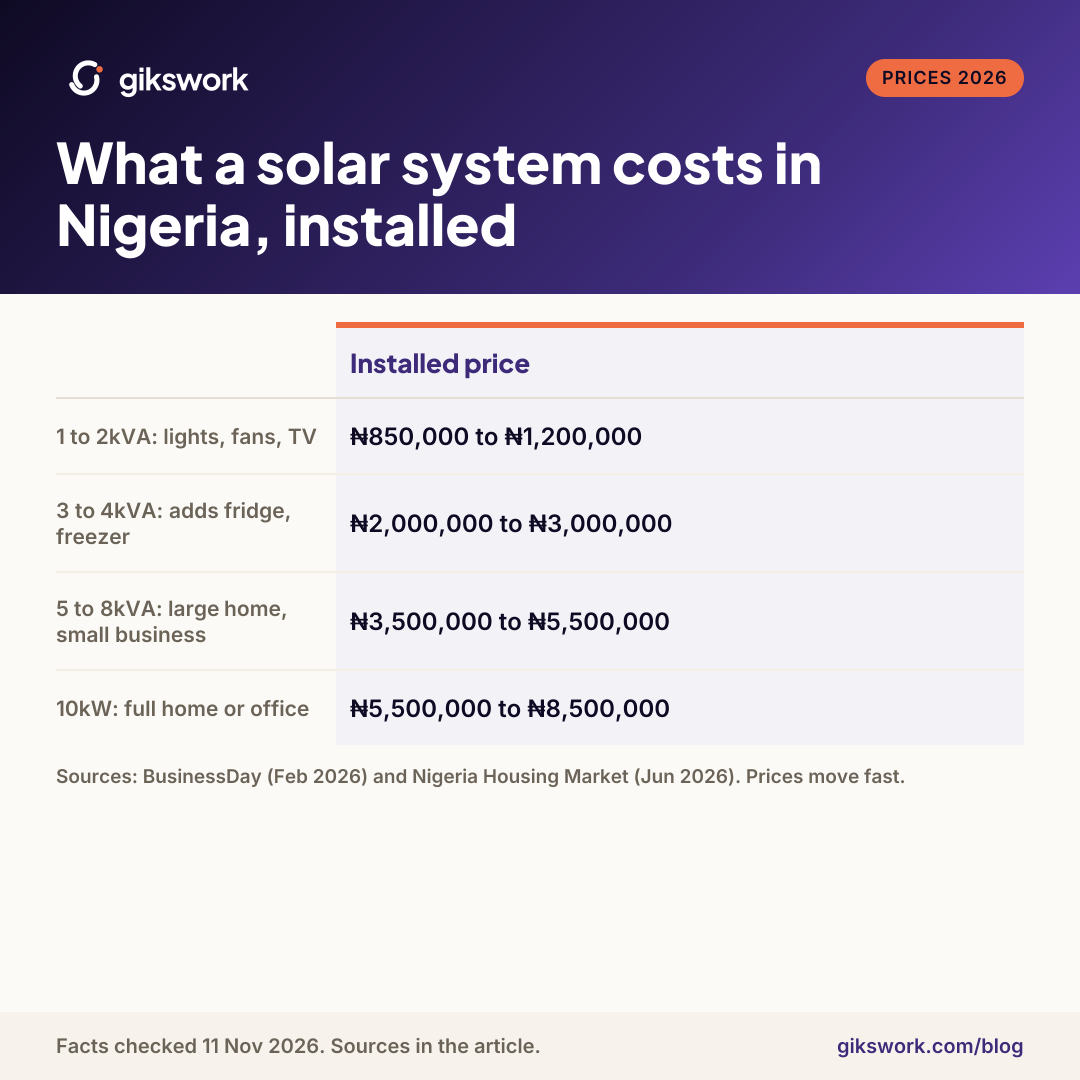
How much does a solar system cost in Nigeria in 2026?
Here are the full-system prices from three 2026 sources. Each includes panels, inverter, batteries and installation.
| System size | What it can run | Installed price | Source and date |
|---|---|---|---|
| 1 to 2kVA | Lights, fans, TV, laptops | ₦850,000 to ₦1,200,000 | BusinessDay, Feb 2026 |
| 1kW | TV, 6 fans, 10 bulbs, laptops | ₦450,000 to ₦650,000 | Nigeria Housing Market, Jun 2026 |
| 3 to 4kVA | Fridge, freezer, TV, fans, lights | ₦2,000,000 to ₦3,000,000 | BusinessDay, Feb 2026 |
| 3.5kVA kit | Medium home | ₦1,100,000 to ₦1,400,000 | Marketplace.ng, Mar 2026 |
| 5 to 8kVA | Large home or small business | ₦3,500,000 to ₦5,500,000 | BusinessDay, Feb 2026 |
| 5kVA hybrid, Lagos | Includes batteries and panels | ₦3,600,000 to ₦5,700,000 | Lagos installer list, Sep 2026, via Finelib |
| 10kW | Full home or office, several ACs | ₦5,500,000 to ₦8,500,000 | Nigeria Housing Market, Jun 2026 |
| 10kW and above | Commercial | ₦10,000,000 to ₦50,000,000+ | BusinessDay and Nairametrics, Feb 2026 |
Sources: BusinessDay, What it costs to install solar in Nigeria today, 17 Feb 2026; Nigeria Housing Market solar price list, updated 3 Jun 2026; Marketplace.ng inverter price guide, 31 Mar 2026; Finelib inverter prices, Sep 2026; Nairametrics, 10 Feb 2026. All checked 11 Nov 2026.
- 1 to 2kVA₦850,000 to ₦1,200,000
- 3 to 4kVA₦2,000,000 to ₦3,000,000
- 5 to 8kVA₦3,500,000 to ₦5,500,000
| Item | Value |
|---|---|
| 1 to 2kVA | ₦850,000 to ₦1,200,000 |
| 3 to 4kVA | ₦2,000,000 to ₦3,000,000 |
| 5 to 8kVA | ₦3,500,000 to ₦5,500,000 |
Cite this chart
Gikswork (2026), "A 5kVA system costs about twice a 3.5kVA one, installed". https://gikswork.com/blog/solar-installation-cost-nigeria#chart-a-5kva-system-costs-about-twice-a-3-5kva-one-insta. Data: BusinessDay, February 2026.
What size do I need for a 3-bedroom flat?
Both BusinessDay and Nigeria Housing Market say a standard 3-bedroom flat usually needs a 3.5kVA to 5kVA system with six to ten 550W panels. Air conditioners, pumps and freezers push you toward the top of that range. A good installer will list your appliances and their hours of use before quoting.
How much do solar panels cost in Nigeria?
From the Nigeria Housing Market 2026 price list (checked 11 Nov 2026):
| Panel | Price per panel |
|---|---|
| 100W | ₦22,000 to ₦35,000 |
| 300W | ₦65,000 to ₦85,000 |
| 450W | ₦95,000 to ₦120,000 |
| 550W | ₦115,000 to ₦145,000 |
| 650W | ₦155,000 to ₦200,000 |
| Jinko 550W N-Type TOPCon | ₦125,000 to ₦150,000 |
Finelib's September 2026 tracker puts a typical panel at ₦115,000 to ₦165,000. So eight 550W panels come to roughly ₦920,000 to ₦1,160,000 at the Nigeria Housing Market prices.
How much are inverters in Nigeria?
Inverter prices for the unit alone:
| Inverter size | Price | Source |
|---|---|---|
| 1 to 1.5kVA | ₦120,000 to ₦200,000 | Marketplace.ng, Mar 2026 |
| 3.5kVA hybrid | ₦380,000 to ₦600,000 | Finelib, Sep 2026 |
| 5kVA hybrid | ₦420,000 to ₦850,000 | Marketplace.ng and Finelib |
| Felicity 5kVA 48V | ₦500,000 to ₦620,000 | Marketplace.ng and Finelib |
| 10kVA hybrid | ₦870,000 to ₦1,500,000 | Finelib, Sep 2026 |
Marketplace.ng notes that premium brands such as Victron can pass ₦1,200,000 for a 5kVA unit. BusinessDay says the inverter makes up 20 to 25 per cent of a system's cost.
How much are solar batteries in Nigeria?
The battery is the biggest single cost. BusinessDay puts batteries at 35 to 45 per cent of a system, with lithium-ion packs from ₦1.15 million to ₦6 million depending on capacity.
| Battery | Rough storage | Price | Source |
|---|---|---|---|
| Felicity 220Ah tall tubular, 12V | About 2.6kWh | ₦385,000 to ₦423,500 | Finelib, Oct 2026 |
| Luminous Inverlast 220Ah tubular, 12V | About 2.6kWh | ₦435,000 | Zit, checked 11 Nov 2026 |
| TIGFOX 5kWh lithium (LiFePO4) | 5.12kWh | ₦1,176,000 | Zit, checked 11 Nov 2026 |
| Felicity 5kWh lithium (LiFePO4) | 5.12kWh | ₦1,360,000 to ₦1,380,000 | Finelib, Oct 2026 |
| Dyness 5kWh lithium | 5.12kWh | ₦1,480,000 to ₦1,718,000 | Finelib, Oct 2026 |
Sources: Finelib solar battery comparison, Zit Luminous 220Ah listing and Zit TIGFOX 5kWh listing, all checked 11 Nov 2026.
- Two Felicity 220Ah tubulars₦770,000 to ₦847,000
- One Felicity 5kWh lithium₦1,360,000 to ₦1,380,000
| Item | Value |
|---|---|
| Two Felicity 220Ah tubulars | ₦770,000 to ₦847,000 |
| One Felicity 5kWh lithium | ₦1,360,000 to ₦1,380,000 |
Cite this chart
Gikswork (2026), "Two tubular batteries cost less than one 5kWh lithium, but last fewer years". https://gikswork.com/blog/solar-installation-cost-nigeria#chart-two-tubular-batteries-cost-less-than-one-5kwh-lith. Data: Finelib solar battery comparison, October 2026.
Why pay more for lithium? BusinessDay says lead-acid batteries last three to five years, while lithium-ion lasts eight to ten years or more. Finelib lists 6,000 or more charge cycles for the 5kWh lithium packs above.
How much do solar installers charge for labour?
Labour is the part people argue about least and check least. Published 2026 figures:
- Small systems, 1 to 2.5kVA: ₦30,000 to ₦70,000 (Marketplace.ng, March 2026, checked 11 Nov 2026).
- Large homes or businesses, 10kVA and above, with trunking: ₦150,000 to ₦350,000 or more (same source).
- Professional installation in general: ₦150,000 to ₦800,000 (BusinessDay, February 2026, checked 11 Nov 2026).
- Charge controllers, mounting, wiring and installation together: ₦330,000 to ₦1,550,000 (BusinessDay).
We found no published 2026 labour rate for a 3.5kVA or 5kVA system on its own. For those, expect a figure between the small and large ranges, and ask the installer to list labour, mounting rails, cables, breakers and surge protection as separate lines. Our wider artisan price guide has electricians' day rates for comparison.
Worked example: a 5kVA system for a 3-bedroom flat
These quantities are for illustration only. Your installer should size your own system.
- Eight 550W panels at ₦115,000 to ₦145,000: ₦920,000 to ₦1,160,000.
- One 5kVA hybrid inverter: ₦420,000 to ₦850,000.
- One Felicity 5kWh lithium battery: ₦1,360,000 to ₦1,380,000.
- Equipment total: about ₦2,700,000 to ₦3,390,000.
- Mounting, cables, breakers and labour on top.
That is in line with BusinessDay's ₦3.5 million to ₦5.5 million for a 5 to 8kVA system once the extras and a larger battery are added.
How do I avoid fake solar panels and batteries?
In July 2026 the News Agency of Nigeria, via Peoples Gazette (checked 11 Nov 2026), reported experts warning that fake batteries and inverters carry the greatest risk because they can overheat, fail early or start fires. Their advice, in short:
- Check the serial number and QR code on the manufacturer's official platform, not just the sticker.
- Ask for original invoices and warranty papers before paying.
- Look for weak finishing, missing details or odd packaging.
- Be wary of prices far below the market.
- Buy from authorised dealers, and have a qualified person test the equipment before it goes on your roof.
How do I hire a trained solar installer?
Even genuine equipment fails if it is badly designed or wired. Ask the installer:
- What training they have. The NBTE published a National Technical Certificate curriculum in Electrical and Solar PV Installation in 2025, examined by NABTEB, and NEMSA certifies electrical contractors, according to Profolio's solar installer guide (checked 11 Nov 2026).
- To show two or three past installations you can call or visit.
- For a written load list and system design before they quote.
- For an itemised quote with labour separate from equipment.
- Who honours the warranty, and how long their own workmanship is covered.
Our checklist for hiring a trustworthy artisan covers ID checks and references in more detail.
What warranty should solar equipment have?
- Panels: Jinko, Canadian Solar, Trina and LonGi carry 25-year performance warranties (BusinessDay).
- Lithium batteries: 5 years is common, for example on the Felicity 5kWh (Finelib) and the TIGFOX 5kWh (Zit).
- Inverters: 1 to 2 years on standard brands and up to 5 on premium brands such as Victron and Huawei (Marketplace.ng). Marketplace.ng advises walking away from any seller who offers no warranty.
Keep the receipts, serial numbers and warranty cards together. A warranty is only useful if you can prove where and when you bought.
Paying safely for solar work and equipment
Big upfront transfers are where many deposit scams in Nigeria start. Having the money held by a third party until the work is done protects both sides, which is how escrow works in Nigeria.
On Gikswork you can hire a solar installer, an inverter and battery technician or a house electrician, or browse every trade. Your payment is held in escrow, secured by EscrowPay, until the job is done. Every worker has their NIN or BVN checked. Employers pay no Gikswork fee, and materials money, such as the panels and batteries you fund for a job, is never charged a fee. The worker pays 10% of their service fee only. See our fees. Installers can join as a worker for free.
If you are buying the equipment yourself, Gikswork Market holds your payment in escrow, secured by EscrowPay, until the goods arrive and you have checked them. Buyers pay no Gikswork fee, and sellers pay the sales fee only when the money is released.
Sources
- BusinessDay, What it costs to install solar in Nigeria today, 17 Feb 2026
- Nairametrics, How much it costs to install a solar energy system in 2026, 10 Feb 2026
- Nigeria Housing Market, Cost of solar panel in Nigeria 2026, updated 3 Jun 2026
- Marketplace.ng, Solar inverter prices in Nigeria 2026, 31 Mar 2026
- Finelib, Inverter prices in Nigeria, Sep 2026
- Finelib, Solar battery comparison, Oct 2026
- Zit, Luminous 220Ah tall tubular battery and TIGFOX 5kWh lithium battery
- Peoples Gazette (NAN), Fake solar panels in Nigeria could cause fire outbreaks, experts warn, 8 Jul 2026
- Profolio, Solar installer pay guide 2026
All checked 11 Nov 2026.
Questions people ask
How much does a 5kVA solar system cost in Nigeria in 2026?
BusinessDay put a 5 to 8kVA system at ₦3.5 million to ₦5.5 million installed in February 2026, and a Lagos installer price list of September 2026, quoted by Finelib, put a 5kVA hybrid with batteries and panels at about ₦3.6 million to ₦5.7 million. Cheaper kits with smaller batteries are sold from about ₦1.7 million, so always check the battery size in the quote.
How much do solar installers charge for labour in Nigeria?
Marketplace.ng's March 2026 guide puts labour at ₦30,000 to ₦70,000 for small systems of 1 to 2.5kVA and ₦150,000 to ₦350,000 or more for 10kVA and above, including trunking. BusinessDay gave a wider range of ₦150,000 to ₦800,000 for professional installation in February 2026. Equipment is extra in both.
How much is a 3.5kVA solar system in Nigeria?
Marketplace.ng listed a 3.5kVA kit at ₦1.1 million to ₦1.4 million in March 2026, while BusinessDay put a 3 to 4kVA system at ₦2 million to ₦3 million installed. The gap is mostly the battery: kits with two tubular batteries cost far less than systems with a lithium battery.
Is a lithium battery better than a tubular battery for solar?
Lithium costs more but lasts longer. BusinessDay says lead-acid batteries last three to five years and lithium-ion eight to ten years or more. In October 2026 Finelib listed a 220Ah tall tubular at about ₦385,000 to ₦435,000 and a Felicity 5kWh lithium at about ₦1,360,000 to ₦1,380,000.
How can I tell if a solar battery or panel is fake?
Experts quoted by the News Agency of Nigeria in July 2026 advise checking the serial number and QR code on the maker's official platform, asking for original invoices, looking for weak finishing or odd packaging, and avoiding prices far below the market. Batteries and inverters carry the highest risk because fake ones can overheat or start fires.
What warranty should I expect on solar equipment?
Major panel brands such as Jinko, Canadian Solar, Trina and LonGi carry 25-year performance warranties, according to BusinessDay. Many lithium batteries are sold with 5 years. Marketplace.ng says standard inverters usually carry 1 to 2 years and premium brands up to 5. Walk away from a seller who offers no written warranty.