Pay on delivery vs escrow: which is safer for online sellers and buyers in Nigeria?
Pay on delivery protects buyers but leaves vendors paying for fake orders and failed trips. Paying upfront protects vendors but puts buyers at risk. See how escrow protects both, and when pay on delivery is still fine.
By Gikswork team · Published 11 Nov 2026 · 10 min read
If you sell on Instagram, WhatsApp or TikTok, you know the argument. The buyer says "I will pay on delivery." You say "Pay first." Both of you are right to be careful, because both of you have heard the stories. This guide shows what each way of paying really costs, who carries the risk, and how to pick the right one for each sale.
| Item | Value |
|---|---|
| Jumia's business in Africa that was pay on delivery, 2019 | 75% |
| Failed deliveries at Jumia, including cancellations and returns, 2019 | 40% |
| Customers who prefer pay on delivery, says Selligate, 2025 | 95% |
Cite this chart
Gikswork (2026), "Pay on delivery is popular, and it fails often". https://gikswork.com/blog/pay-on-delivery-vs-escrow-nigeria#chart-pay-on-delivery-is-popular-and-it-fails-often. Data: Bloomberg via TechCentral, Sep 2019; Selligate via ThisDay, Jul 2025.
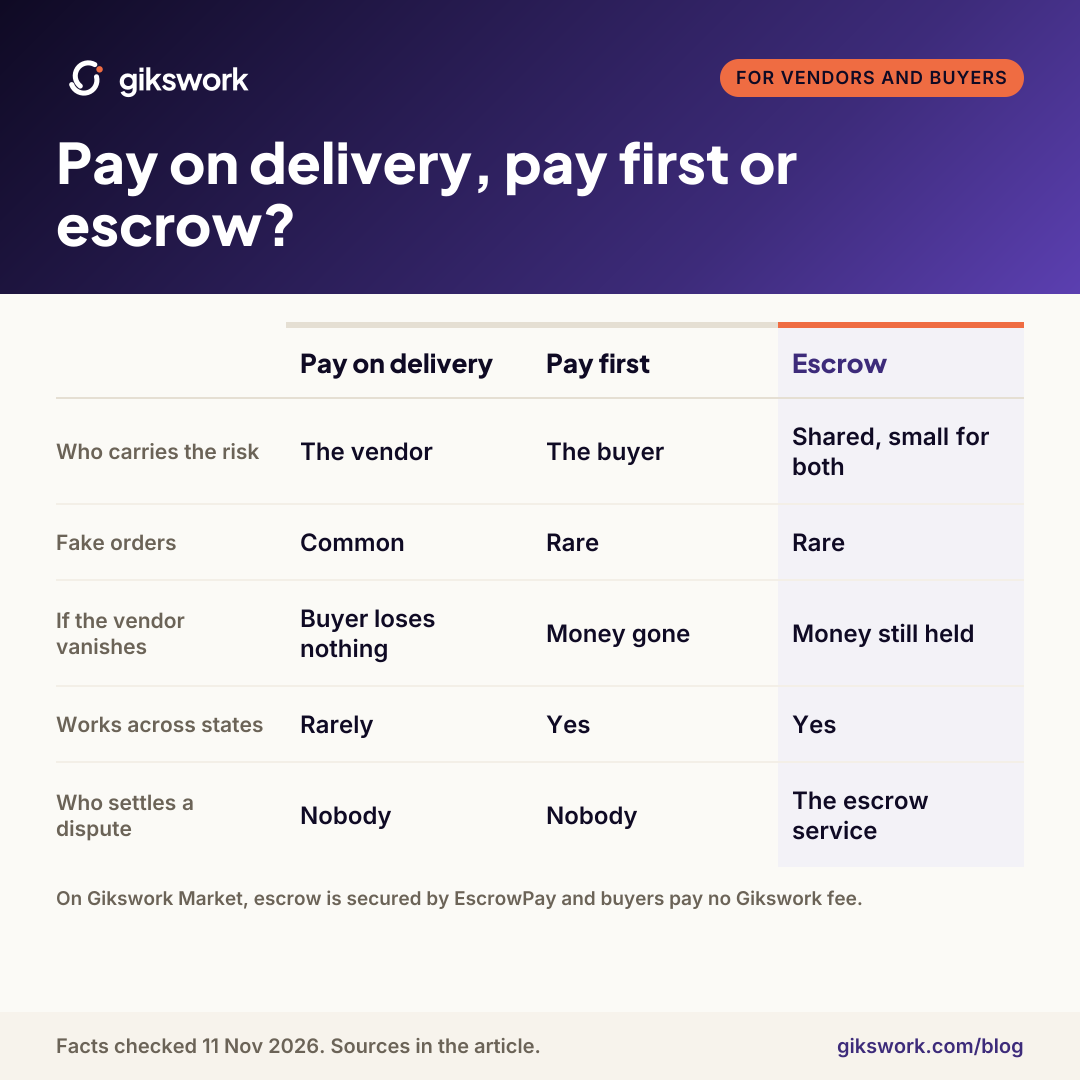
Pay on delivery, paying upfront or escrow: which is safest?
| Pay on delivery | Paying upfront | Escrow | |
|---|---|---|---|
| Who carries the risk | The vendor | The buyer | Shared, and small for both |
| Buyer sees the item before the money moves | Yes | No | Yes, before the money is released |
| Vendor knows the buyer can pay | No | Yes | Yes, the money is already held |
| Fake orders | Common, and the vendor pays for the trip | Rare | Rare, a fake buyer will not pay in |
| If the vendor disappears | The buyer loses nothing | The money is gone | The money is still held |
| Works across states | Rarely | Yes | Yes |
| Who settles a dispute | Nobody | Nobody | The escrow service |
| Cost | The vendor's lost trips | None, until something goes wrong | A small fee |
What does a failed pay on delivery order cost a vendor?
More than most buyers think. When a buyer refuses the item at the gate, switches off their phone, or "is not around today", the vendor still pays:
- The rider, twice. Once for the trip out and again to bring the item back, or for a second attempt.
- Stock that cannot be sold. While the item is on a bike in traffic, another real buyer cannot have it. Food, cakes and perishable items may not be sellable at all by the time they come back.
- Time and data. Calls, follow ups, packing and repacking.
Big platforms have felt this for years. In 2019, Jumia told Bloomberg that up to 75% of its business in Africa was pay on delivery, and investors were worried by failed deliveries of some 40% across its 14 countries, a figure that includes cancellations and returns (Bloomberg via TechCentral, 20 Sep 2019, checked 11 Nov 2026). Back in 2016, the founder of the online grocer Supermart estimated that half of the Nigerian customers who choose cash on delivery do not end up buying (How we made it in Africa, 8 Nov 2016, checked 11 Nov 2026).
- Pay on delivery75%
- Prepaid25%
| Item | Value |
|---|---|
| Pay on delivery | 75% |
| Prepaid | 25% |
Cite this chart
Gikswork (2026), "How Jumia's orders in Africa were paid, 2019". https://gikswork.com/blog/pay-on-delivery-vs-escrow-nigeria#chart-how-jumia-s-orders-in-africa-were-paid-2019. Data: Bloomberg via TechCentral, 20 Sep 2019.
A big company can spread the cost over millions of orders. A small vendor with ten orders a week cannot. Two failed trips can wipe out the profit on the whole week.
What do fake pay on delivery orders look like?
Selligate, a company that sells tools to Nigerian vendors, described the patterns it sees in "serial cancellers" to ThisDay: phone numbers that cannot be reached, buyers who confirm and then disappear on delivery day, orders cancelled within minutes, endless postponing, and buyers who reject the product with false complaints (ThisDay, Jul 2025, checked 11 Nov 2026). The same company says nearly 95% of customers still prefer pay on delivery. That is its own figure, but every vendor knows the feeling.
There is a second trap at the door: the fake transfer alert. The buyer "pays" by transfer when the rider arrives and shows a screenshot or a fake SMS. In June 2025 Legit.ng reported a cake vendor who sent yam peels to a client after the client tricked her with a fake transfer, and she had her rider collect the delivery fee first (Legit.ng, 24 Jun 2025, checked 11 Nov 2026). Funny on social media, but she still paid her rider.
Why are buyers afraid to pay upfront?
Because once the money leaves your account, nobody holds it for you. If the vendor sends the wrong item, a fake, or nothing at all, your only hope is the vendor's good will.
The numbers are not small. A CBN document reported by Nairametrics shows bank customers lost ₦134.48 billion to fraud between 2020 and 2025, and that e-commerce fraud incidents rose by 1,961% in 2023 (Nairametrics, 19 Jun 2026, checked 11 Nov 2026). Our guides on buying from Instagram vendors safely and deposit scams in Nigeria cover the red flags in detail.
So honest vendors pay the price for fake vendors, and honest buyers pay the price for fake buyers. Each side asks the other to carry all the risk.
How does escrow fix both sides?
Escrow puts a neutral party in the middle. The buyer pays first, but into a held account, not to the vendor. The vendor sends the item knowing the money is real and already set aside. The buyer checks the item, and only then is the money released. Read what escrow is and how it works in Nigeria for the basics.
For a vendor, this ends the two biggest losses of pay on delivery:
- No more fake orders. A person who was never going to buy will not transfer real money into escrow first.
- No more fake alerts. The money is confirmed in escrow before you dispatch, not on a screenshot at the gate.
For a buyer, it ends the biggest risk of paying upfront: if the item never comes or is not as described, the money is still held and someone looks at the evidence.
How does it work on Gikswork Market?
Every order on Gikswork Market is paid into escrow, secured by EscrowPay. This is how an order goes, checked against our own code on 11 Nov 2026:
- The buyer pays into escrow by bank transfer. Each order gets its own escrow account, and the stock is held for 30 minutes while the transfer arrives. An unpaid order simply lapses and the items go back on sale, so a fake order costs the vendor nothing.
- The seller accepts within 24 hours or the order is cancelled and refunded, then sends the item with proof such as a photo, a tracking number or the rider's name and phone. Delivery is agreed between buyer and seller in the order chat.
- The buyer checks. They have 48 hours for most goods, and 72 hours for vehicles and for electronics over ₦500,000.
- The seller is paid when the buyer confirms, or when the check time ends with no problem raised, less Gikswork's fee.
- If there is a problem, the buyer raises it with photos and the money stays frozen. Both sides send evidence and our team decides: release, refund, part refund, return then refund, or "Get it from another seller", where the money moves to the same item from another verified seller with no new escrow fee.
What it costs. The seller pays a 4% sales fee when the money is released, at least ₦300 and at most ₦20,000 for sales up to ₦2,000,000, and a flat ₦40,000 above that. Buyers pay no Gikswork fee, but they pay EscrowPay's holding fee on top of the price: 1.5% plus ₦150, at most ₦3,000, up to ₦250,000, and 1.25% plus ₦150 above that. The buyer sees the price and that fee as one total. Full details are on our fees page.
- ₦5,000 item₦300
- ₦15,000 item₦600
- ₦50,000 item₦2,000
- ₦250,000 item₦10,000
- ₦800,000 item₦20,000
- ₦3,000,000 item₦40,000
| Item | Value |
|---|---|
| ₦5,000 item | ₦300 |
| ₦15,000 item | ₦600 |
| ₦50,000 item | ₦2,000 |
| ₦250,000 item | ₦10,000 |
| ₦800,000 item | ₦20,000 |
| ₦3,000,000 item | ₦40,000 |
Cite this chart
Gikswork (2026), "Gikswork Market sales fee, paid by the seller, by item price". https://gikswork.com/blog/pay-on-delivery-vs-escrow-nigeria#chart-gikswork-market-sales-fee-paid-by-the-seller-by-it. Data: Gikswork Market fee rule, checked 11 Nov 2026.
| Item price | Buyer pays (price + EscrowPay fee) | Gikswork fee, from the seller | Seller receives |
|---|---|---|---|
| ₦5,000 | ₦5,225 | ₦300 | ₦4,700 |
| ₦15,000 | ₦15,375 | ₦600 | ₦14,400 |
| ₦50,000 | ₦50,900 | ₦2,000 | ₦48,000 |
| ₦250,000 | ₦253,000 | ₦10,000 | ₦240,000 |
One rule to know before you pay. No fee is refunded on Gikswork Market, whoever is at fault. A full refund is the item price less Gikswork's fee, and EscrowPay's fee is not returned. On a ₦15,000 item the buyer pays ₦15,375 and a refund gives back ₦14,400. Compare that with ₦600 against two wasted rider trips, or against losing ₦15,000 to a fake vendor.
When is pay on delivery still fine?
Escrow is not always the best answer. Be fair to your buyers and to yourself:
- Meeting locally. If the buyer lives close, meet in a busy public place, let them inspect, and take payment there. Confirm the transfer has landed in your own banking app before you hand over the item, never a screenshot.
- Cheap items. On a ₦3,000 item, a refused trip is a small loss and escrow may feel like too much.
- Regular customers. Someone who has paid you on delivery ten times without wahala has earned it.
- Buyers who come to you. Pick up from your shop, inspect, pay. Nothing to fail.
Pay on delivery stops making sense when the item travels far, is expensive, is made to order, or the buyer is a stranger. That is where escrow earns its fee.
How can vendors cut failed deliveries today?
- Offer escrow as the default for strangers, and pay on delivery only for local meetups and regular customers.
- Call to confirm every pay on delivery order before dispatch, and check that the number is reachable.
- Collect the delivery fee first on pay on delivery orders, so a refusal does not cost you the rider.
- Never release goods on a screenshot. Check your own bank app.
- Keep a record of buyers who refuse without a reason.
- Put a protected checkout link in your bio so the escrow talk is short. Open a shop on Gikswork Market and send buyers your listing.
Selling on bigger platforms too? Compare options in Gikswork Market vs Jiji and selling on Jumia, Konga or Gikswork Market.
Sources
- TechCentral (Bloomberg), 20 Sep 2019: Jumia shows e-commerce in Africa is hard work, checked 11 Nov 2026
- How we made it in Africa, 8 Nov 2016: How former Jumia MD is selling groceries online in Nigeria, checked 11 Nov 2026
- ThisDay, Jul 2025: Selligate deploys AI to tackle serial pay on delivery order cancellers in Nigeria, checked 11 Nov 2026
- Legit.ng, 24 Jun 2025: Cake vendor delivers yam peels to client who tricked her with fake transfer, checked 11 Nov 2026
- Nairametrics, 19 Jun 2026: Bank customers lose ₦134.48 billion to fraud in six years, CBN, checked 11 Nov 2026
- Gikswork Fees page
Questions people ask
Why do vendors in Nigeria refuse pay on delivery?
Because every failed pay on delivery order costs the vendor money. They pay the rider for the trip there and back, the stock is stuck in traffic instead of being sold, and some orders are fake from the start. Many vendors now ask for payment first or for a delivery fee before dispatch.
How do I stop fake pay on delivery orders?
Ask the buyer to pay into escrow before you send anything. A person who places a fake order will not pay into escrow, and a real buyer is still protected because you are paid only after they confirm the item. If you must offer pay on delivery, call to confirm the order, collect the delivery fee first and never release the item on a transfer screenshot alone.
Is pay on delivery safer than paying upfront for buyers?
Yes, when you can inspect the item at the door and pay only after you are happy. Paying upfront to a stranger is the riskiest option, because nobody holds the money if the item never comes. Escrow gives you the same protection as pay on delivery, even when the item travels between states.
Who pays the fees on Gikswork Market escrow?
The seller pays Gikswork's 4% sales fee when the money is released: at least ₦300 and at most ₦20,000 for sales up to ₦2,000,000, and a flat ₦40,000 above that. The buyer pays no Gikswork fee but pays EscrowPay's holding fee on top of the price. No fee is refunded if an order is refunded.
When is pay on delivery still a good idea?
When the buyer and seller are in the same area and can meet in a safe public place, the buyer can inspect the item properly, and the seller loses little if the buyer walks away. For cheap items bought locally, that is often simpler than escrow.